



New! Render PlantUML diagrams directly inside GitHub
with our official browser extension —
No server. No tokens. No tracking. Zero permissions but clipboard. —
Try it out and let us know what you think!
ArchiMate Diagram
 Edit in Dokuwiki
 Edit in Asciidoc
 Edit in Markdown
 Archimate keyword
You can use the archimate keyword to define an element. Stereotype can optionally specify an additional icon. Some colors (Business, Application, Motivation, Strategy, Technology, Physical, Implementation) are also available.

Defining Junctions
Using the circle keyword and the preprocessor, you can also create junctions.
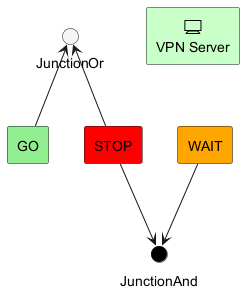
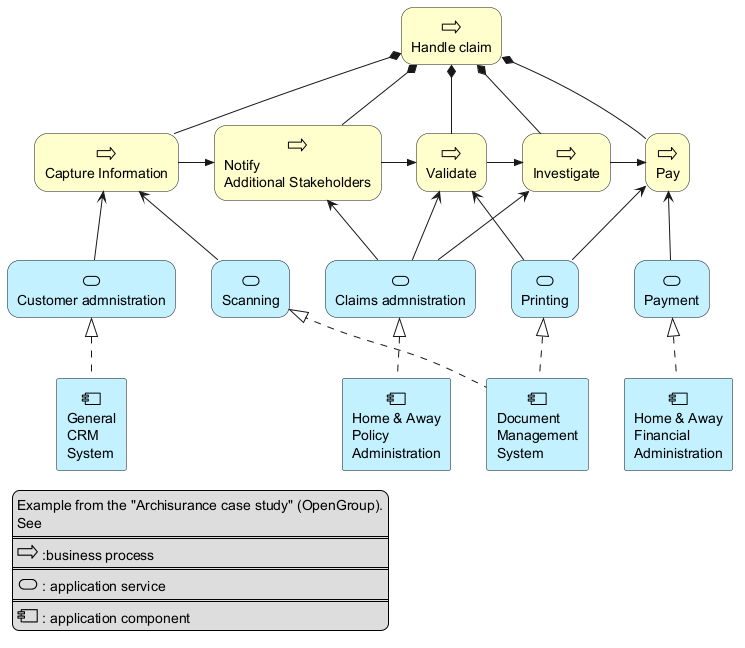
Ejemplo 1
WARNING
This translation need to be updated. WARNING
Example 2
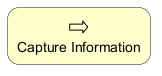
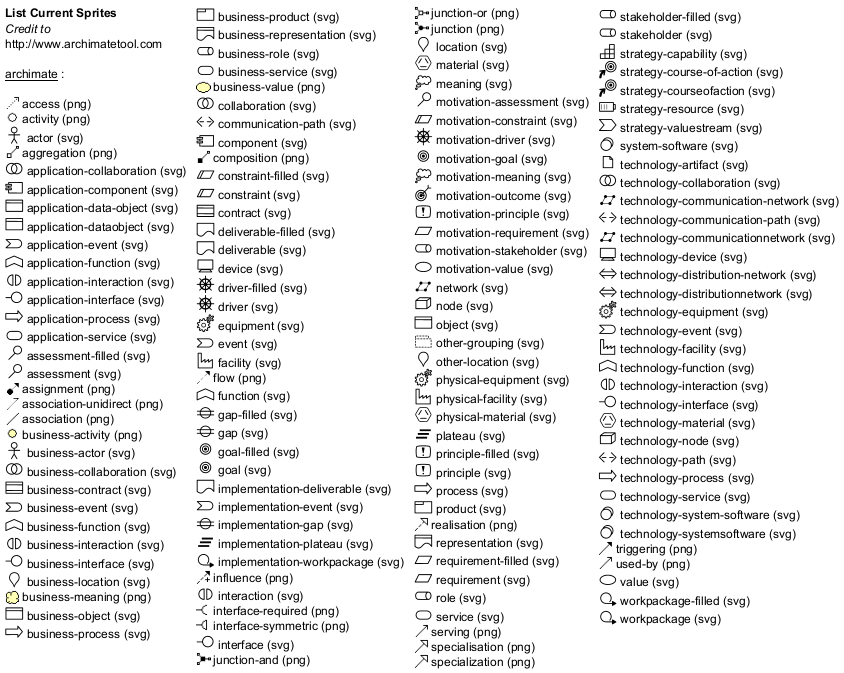
List possible sprites
You can list all possible sprites for Archimate using the following diagram:
ArchiMate Macros
Archimate Macros and Library
A list of Archimate macros are defined Archimate-PlantUML here which simplifies the creation of ArchiMate diagrams, and Archimate is natively on the Standard Library of PlantUML.Archimate elements
Using the macros, creation of ArchiMate elements are done using the following format:Category_ElementName(nameOfTheElement, "description")
For example:
- To define a Stakeholder element, which is part of Motivation category, the syntax will be
Motivation_Stakeholder(StakeholderElement, "Stakeholder Description"):
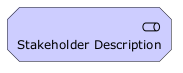
- To define a Business Service element,
Business_Service(BService, "Business Service"):

Archimate relationships
The ArchiMate relationships are defined with the following pattern:Rel_RelationType(fromElement, toElement, "description")
and to define the direction/orientation of the two elements:
Rel_RelationType_Direction(fromElement, toElement, "description")
The RelationTypes supported are:
- Access
- Aggregation
- Assignment
- Association
- Composition
- Flow
- Influence
- Realization
- Serving
- Specialization
- Triggering
Directions supported are:
- Up
- Down
- Left
- Right
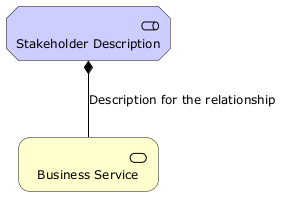
- To denote a composition relationship between the Stakeholder and Business Service defined above, the syntax will be
Rel_Composition(StakeholderElement, BService, "Description for the relationship")
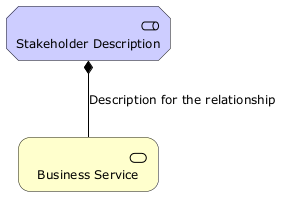
- Unordered List ItemTo orient the two elements in top - down position, the syntax will be
Rel_Composition_Down(StakeholderElement, BService, "Description for the relationship")
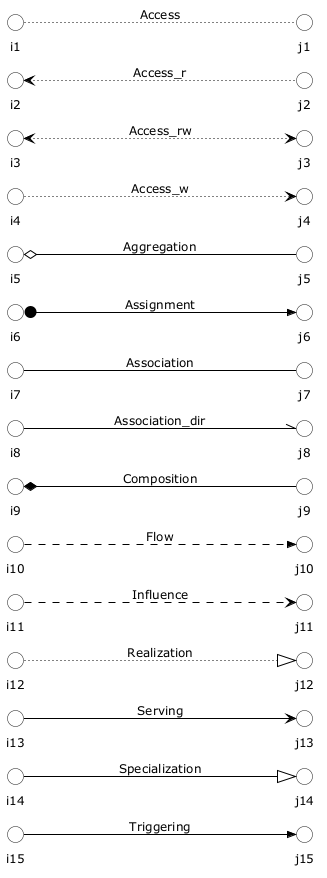
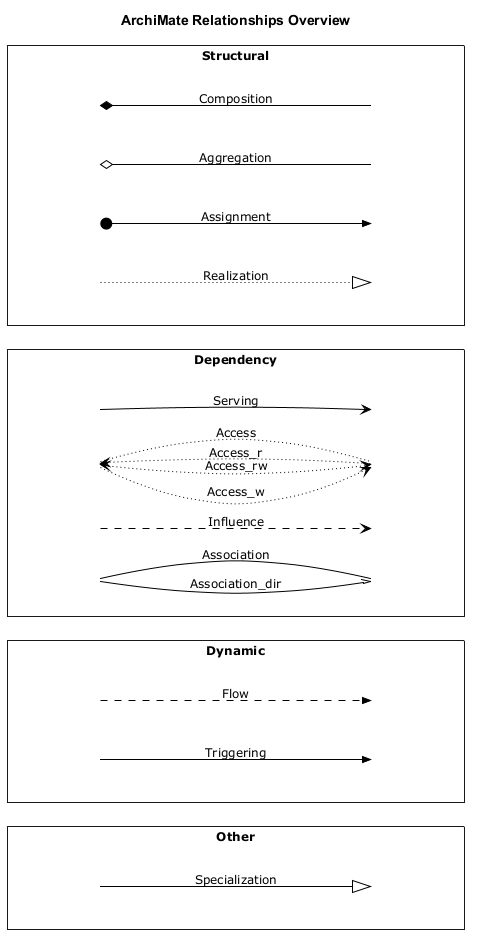
Appendice: Examples of all Archimate RelationTypes